

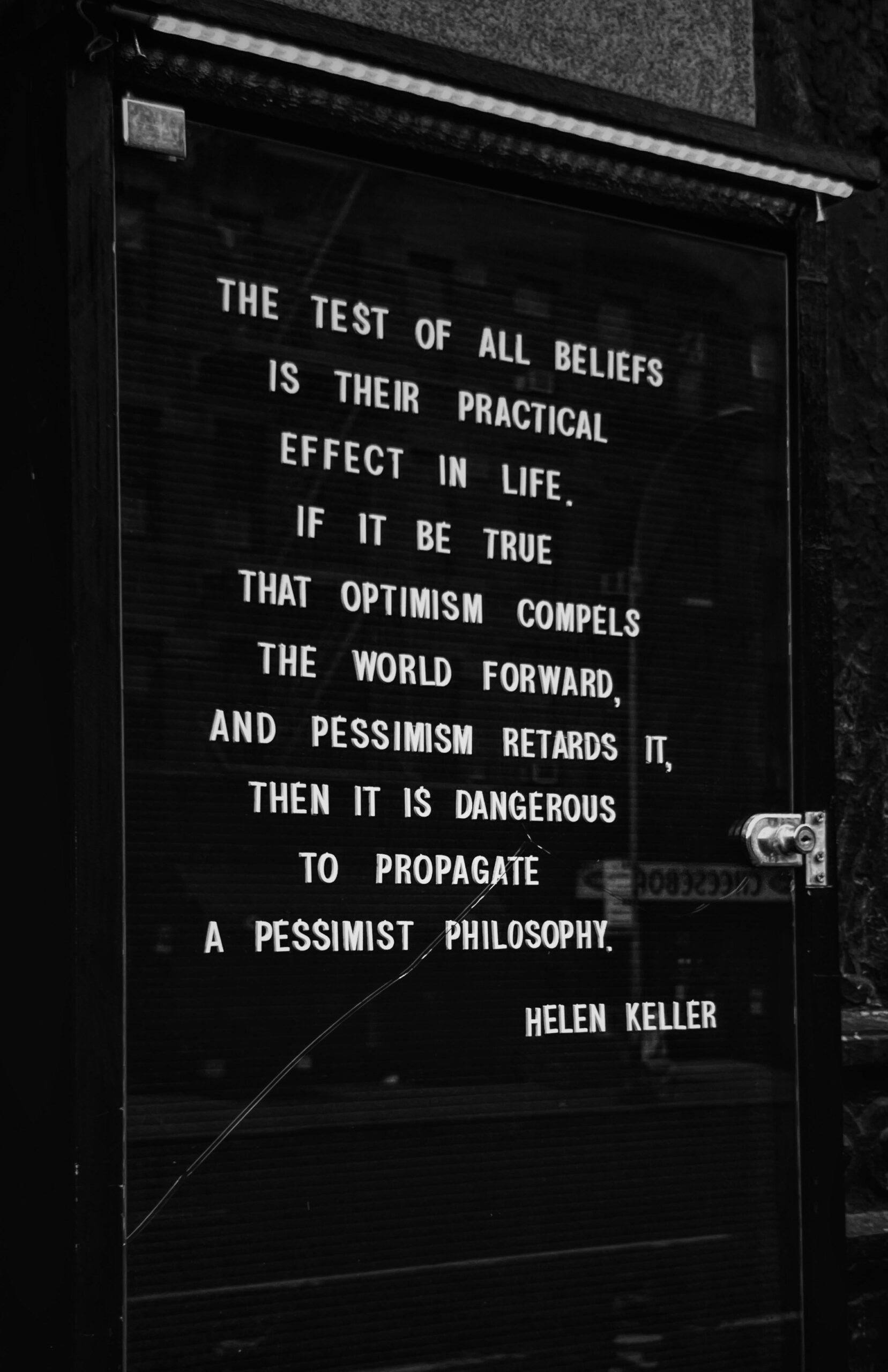

The word on the street is that everyone in America is exhausted. They are burnt out. Many people are suffering from existential nihilism.
At its core, nihilism is a philosophical view holding that life and the universe have no inherent meaning, purpose, or objective moral truths. The modern paradox of this worldview is a cruel trick: we are told that life on a macro, cosmic level has no meaning, yet on a micro, individual level, we are commanded to invent our own purpose from scratch.
Question: How many of you have ever stopped to ask where your country’s default belief system comes from?
Almost none of you. People do not naturally do that. When you are born into this world, you simply accept whatever is handed to you by your parents or your culture. You go through a school system that explains why the world is the way it is and what you are supposed to do with your life.
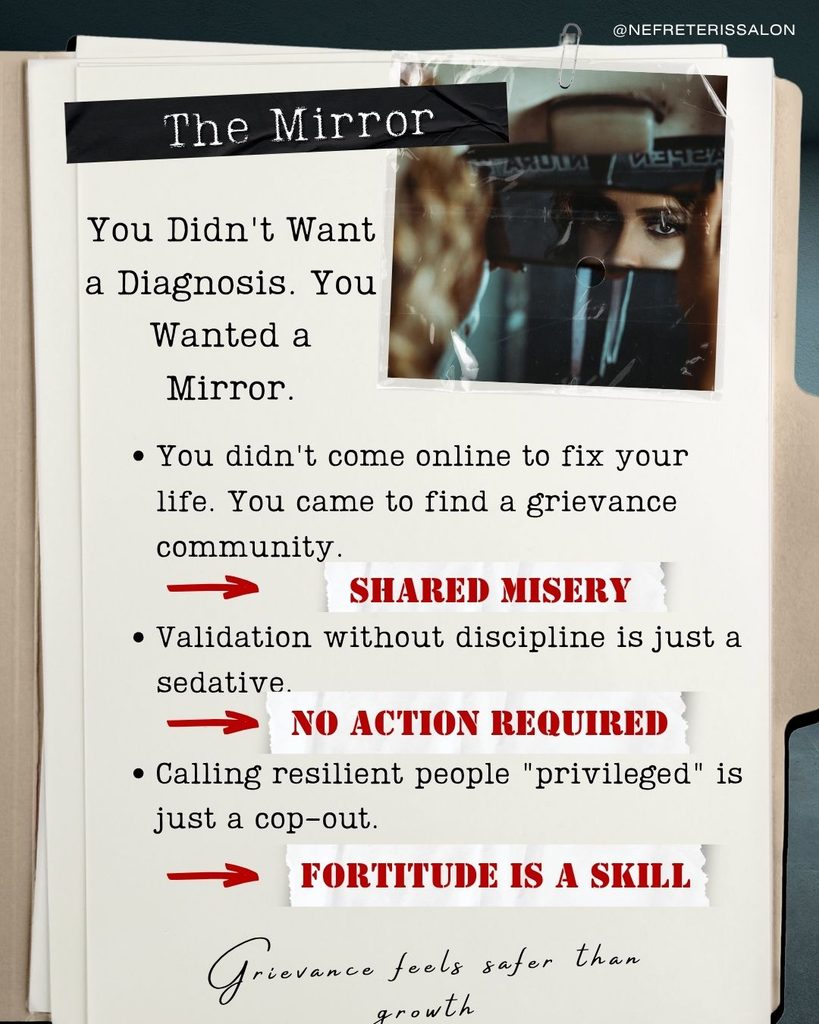
Everything is handed to you as a child. It is very rare for someone to stop and ask why they believe what they believe. Today, we are experiencing a profound absence of meaning. People are wondering why everyone is so exhausted. Instead of looking for a clinical diagnosis, many people go online looking for a mirror or a tribe. They look for communities to share their grievances about society. You log on and find people saying that life sucks, there is no purpose, and there is nothing to look forward to.
The Anomaly of Resilience
Question: What happens if you run into someone who is not miserable? What happens when you meet someone who looks at the exact same world, yet does not suffer from existential dread?
Your first instinct might be to call this person a fraud, an outlier, or someone who won the genetic lottery. You try to tune them out. Rarely do people admit that this person possesses true fortitude—an acquired skill that was actually worked for.
We are not the first humans to walk this earth. Philosophers before us asked baseline questions and formulated answers. Friedrich Nietzsche talked extensively about the existential nihilism we are experiencing right now. When he proclaimed that “God is dead,” he was not celebrating. He was issuing an apocalyptic warning.
“When people throw out transcendent frameworks, we throw the burden of creating meaning entirely onto individual shoulders.”
Nietzsche realized that religion served as a massive framework for how people lived their lives. When societies discarded those frameworks, the burden of creating meaning shifted entirely to the individual. He also knew that the vast majority of humanity could not hold the weight of being their own god.
The Rise of Expressive Individualism
By the twentieth century, these philosophical ripples collided to create expressive individualism. The cultural mandate became clear: be yourself, write your own rules, and define your own truth. Essentially, you must manufacture an entire framework for living from scratch.
The self-help industry manufactured a false Übermensch. In Thus Spoke Zarathustra, Nietzsche conceptualized the Übermensch as an idealized individual capable of facing isolation and creating their own moral framework. Even Nietzsche recognized this as an almost impossible feat for the masses.
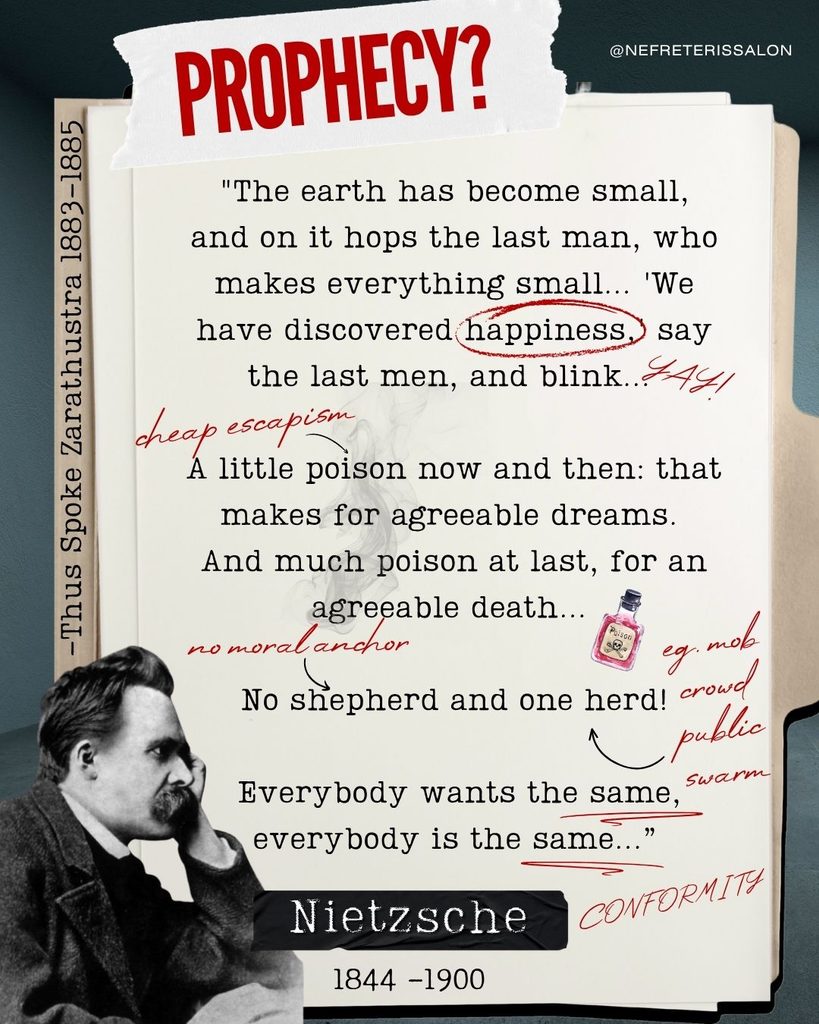
Instead of sovereign thinkers, we filled our culture with what he called the “last man“. These individuals are built for hedonism, safety, and easy comfort. We are literally dying of comfort in America because we have infinite warm shelter, absolute safety, and zero transcendent purpose. Technology has amplified this isolation, breeding an intense aversion to friction, confrontation, and disagreement.
Read: The Identity Trap: Why Trying to Invent Yourself Fails
The Allure of the Pill Over “Physical Therapy”
Everyone wants validation, and everyone demands that we validate one another. Because we want everything to be easy, we look to Big Pharma or quick-fix content creators for a pill or a patch to fix our souls. We want a ten-minute video to cure our existential dread so we can live happily ever after.
“The cure is not medicine. It’s more like a metaphorical physical therapy, PT. It’s repetitive, uncomfortable, daily work.”
The moment people realize the cure requires effort rather than a pill, they run right back to their grievance communities to feel safe. We want answers, but we refuse to do the work required to sustain them. Modern people kicked out all authority, tradition, and structure in the name of absolute freedom. In doing so, we paralyzed ourselves because we discarded the rulebook.
The Crossroads: Dethrone Yourself or Stay Trapped
We’ve reached a clear crossroads.
Road A (The Kierkegaardian Correction):
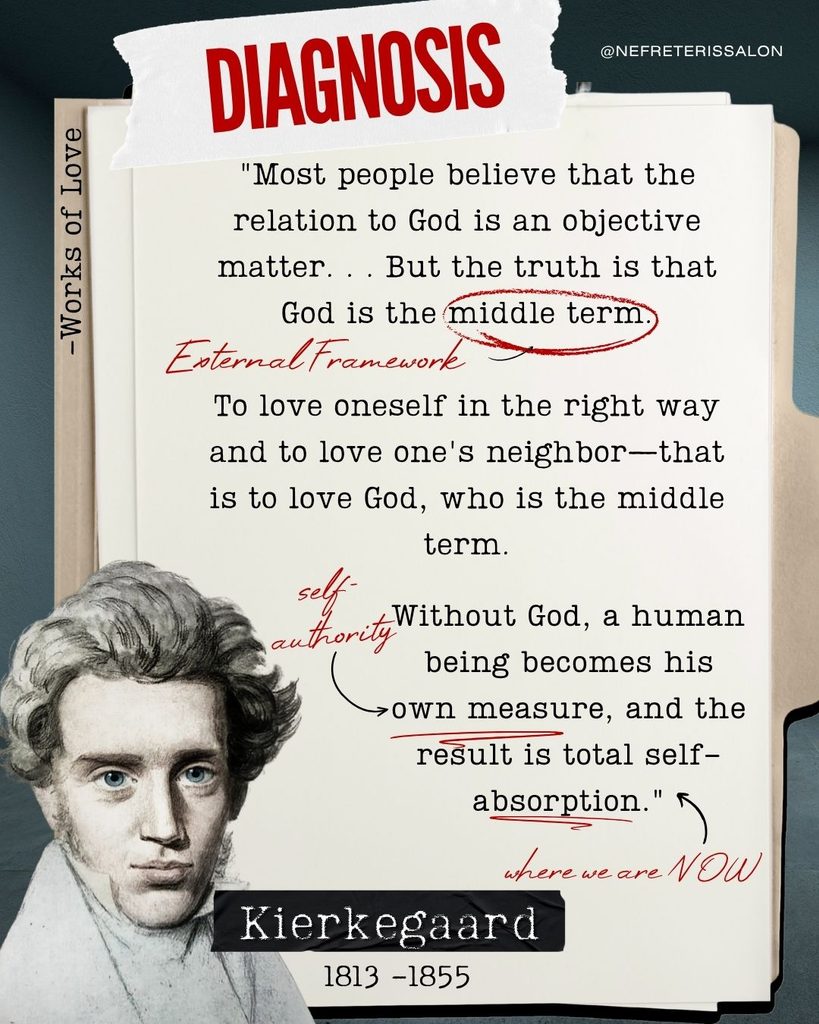
You dethrone yourself. As Søren Kierkegaard diagnosed, when you throw out external standards and demand total autonomy, human beings become their own measure, and the result is total self-absorption. To reverse this, you must step down from the throne of your own ego and accept a transcendent, external framework—relying on a reality bigger than yourself where you are not the center.
To the modern mind, this “leap of faith” feels completely absurd because it requires two things our culture despises: humility and the total surrender of control. We are trained in self-preservation and skepticism, taught to believe that holding onto self-sovereignty is the only safety net we have left.
The Reality of the Wager
This is where Blaise Pascal strips away the intellectual posturing. In his famous Wager, Pascal pointed out that every human being is already forced to bet their life on something—neutrality is impossible. The nihilist claims that surrendering to an unseen, external God is a foolish gamble with zero guarantee.
But if your self-constructed universe is already collapsing into isolation, paranoia, and dark spirals, Pascal’s logic cuts straight through the pride: What, exactly, do you have left to lose?
If you bet on your own ultimate authority and you are wrong, you gain a temporary illusion of control while paying for it with real-time decay and eternal ruin. But if you make the leap—if you wager your pride, step off the throne, and surrender to a transcendent reality—you trade a failing, self-made hell for actual life, rest, and truth.
When your autonomy is the very thing driving you into freefall, the “leap of faith” ceases to be an abstract theological debate. It becomes the only rational move left on the board. You are already drowning; the only hand that can pull you out is the one outside yourself.
Road B (The Trap of the False Übermensch):
You remain the supreme authority of your own life. You attempt to play Nietzsche’s Übermensch—trying to manufacture your own absolute values and go it entirely alone. But let’s be honest about what you’re actually doing: Nietzsche envisioned the Will to Power as a brutal, rare, and deeply painful process of self-sculpting meant for an exceptionally disciplined fraction of humanity. It shares a thread with Thomas Carlyle’s assessment of greatness in On Heroes, Hero-Worship, and the Heroic in History—though Carlyle’s lens began with God, while Nietzsche’s ended with man.
Nietzsche would look at today’s culture with absolute contempt. Modern society has reduced his terrifying standard to mere “Main Character Syndrome”—romanticizing daily mundane struggles, wrapping isolation in a high-contrast aesthetic, and calling self-absorption “greatness.”
It is the Übermensch without the work; the crown without the trial.
Even Nietzsche himself, a brilliant mind, collapsed under the weight of his own philosophy. It is an idealized, near-impossible standard that leaves ordinary human beings suffocating on a blank canvas. If you choose Road B without relentless internal discipline and the grit to endure severe emotional, physiological, and spiritual pain, you aren’t self-mastering—you are just being driven by your shifting feelings and convenience. You become what Nietzsche called the “Last Man,” all while wearing the costume of the Hero, watching yourself sink deeper into isolation, paranoia, and despair.
Nihilism does not have to be the end of the story. True recovery begins the moment we stop worshiping at the altar of the self, step down from the throne, and return to an external, shared standard—where truth is objective and we are no longer our own fragile measures.
To Ponder
- Where in your daily life are you mistaking performative isolation for strength?
- Have you grown exhausted trying to manufacture your own meaning from scratch on a blank canvas?
- If your self-constructed reality is the very thing driving your quiet decay, what are you actually holding onto—and what do you have left to lose?